


Last Updated: October 28, 2026
Quick Summary
To vet online product quality, check the seller first for real contact details, a clear return policy, and secure checkout. Then compare specifications side by side, read recent one- and two-star reviews for repeated complaints, and confirm any certification marks in the certifying body's own database.
- Check the seller's contact details, return policy, and secure checkout before evaluating the product.
- Sort reviews by most recent and read one- and two-star reviews for repeated, specific complaints.
- Look up certification marks in the certifying body's own database and confirm the model number matches.
- A near-flawless rating with no critical reviews may mean negative feedback is being suppressed.
- Save screenshots of certification claims and warranty terms to support any later return or safety complaint.
Table of Contents
- Why Vetting Online Product Quality Matters Before You Buy
- Step 1: Check the Seller Before You Check the Product
- Step 2: Compare Product Specifications Side by Side
- Step 3: Learn How to Spot Fake Product Reviews
- Step 4: Use an Online Shopping Product Quality Checklist
- Step 5: Evaluate Photos, Videos and Seller Claims
- Step 6: Decide Whether to Buy, Test or Skip Based on Risk
- Booking Your First Order With Confidence at LumBrook
- Frequently Asked Questions
Why Vetting Online Product Quality Matters Before You Buy
Online shopping makes it easy to buy almost anything with a few taps.
Many shoppers learn this the hard way.
A smart checklist helps you judge any online product with confidence.
Here is the simple rule: don't trust one signal.
Related reading: How to Find High Quality Home Goods: A 2026 Guide covers broader ways to judge quality across categories.
Step 1: Check the Seller Before You Check the Product
Start with the seller, not the item. A great product from an unreliable seller can still leave you with a refund fight, a late delivery, or no support.
Look for these signs of a trustworthy seller:
- Clear contact details: A working email, phone number, or contact form.
- A real return policy: It should be easy to find and written in plain language.
- Visible business information: Company name, physical address, and terms of service.
Watch out for stores with no contact information, prices far below every other seller, or a return policy hidden in tiny print.
Related reading: Best Online Stores for Curated Essentials compares trustworthy places to shop for everyday items.
Step 2: Compare Product Specifications Side by Side
Specifications tell you what a product is made of and how it performs. Marketing copy often hides the details that matter, so compare the numbers.
Use this approach:
- Open the spec sheet. Look for materials, dimensions, weight, capacity, and care instructions.
- Line up two or three similar items. Put their specs in a simple list or spreadsheet.
- Flag missing details. A seller who won't list materials or dimensions is hiding something.
- Check the units. Make sure you compare inches to inches and pounds to pounds.
- Match specs to your real use. A candle holder for a bathroom needs different materials than one for a dining table.
When you compare how to compare product specifications, focus on the few numbers that affect use: size, material thickness, weight limits, and warranty length.
Step 3: Learn How to Spot Fake Product Reviews
Reviews are useful, but they can be manipulated. Knowing how to spot fake product reviews helps you separate real feedback from paid or bot-written praise. The problem is that most advice stops at "watch for vague praise." A more reliable approach is to run a short, repeatable audit and to understand what the signals can and cannot prove.
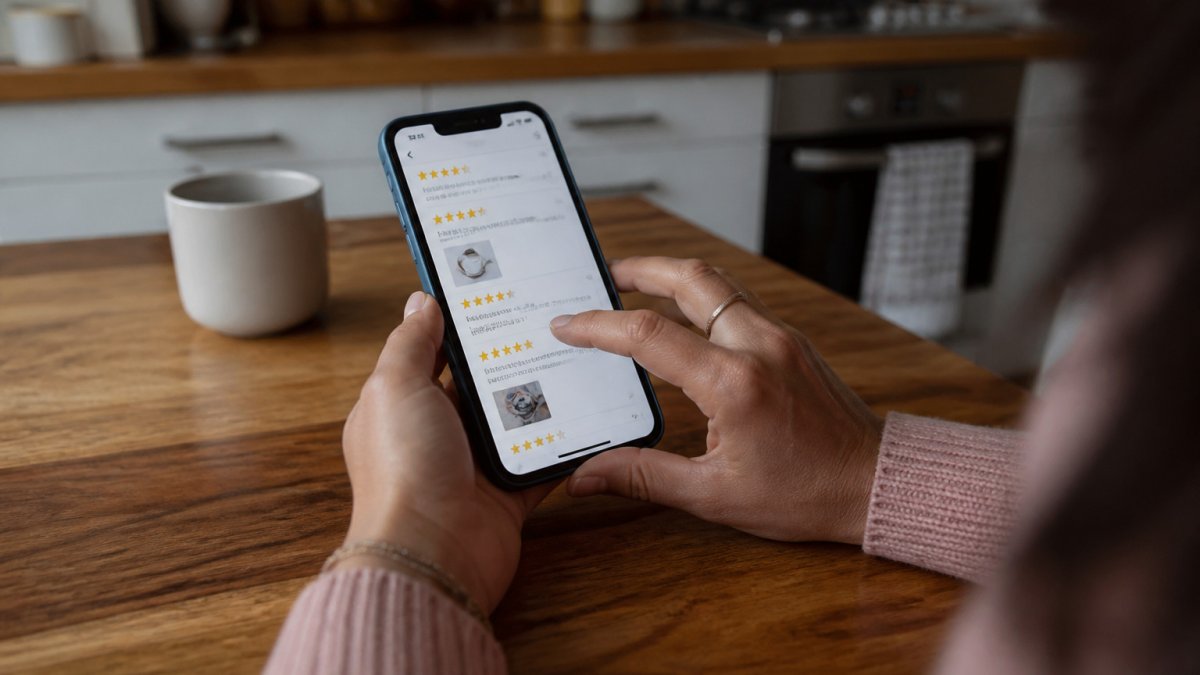
A four-pass review audit
Work through these passes in order. Each one takes a minute or two.
- Sort by most recent, not most helpful. Platforms often default to "top reviews," which can be gamed. Sorting by newest shows whether quality is holding up after the launch buzz fades.
- Read the one- and two-star reviews first. Look for specific, repeatable complaints, a seam that splits, a battery that dies after two months, a size that runs small. A single angry review is noise; the same complaint across several reviewers over several months is a pattern.
- Open reviewer profiles. On major platforms you can click a reviewer's name to see their history. Red flags include accounts created the same week as the review, accounts that have reviewed only one brand, and accounts with a burst of five-star reviews on unrelated products in a short window.
- Check the timeline. Plot the review dates in your head. A cluster of dozens of five-star reviews in a single day, followed by months of silence, is a classic paid-review pattern. Organic reviews arrive steadily and spread across the product's life.
What the signals can and cannot tell you
These checks are useful, but they are not proof. A vague five-star review may be a real customer who simply writes briefly. Review-fraud detection is probabilistic, not definitive, and platforms themselves struggle with it, which is why the Federal Trade Commission has pursued cases against sellers who buy fake reviews and why the agency's 2024 rule bans selling or buying fake reviews and fake review suppression (the FTC).
Cross-check outside the product page
Reviews on the seller's own site are the easiest to curate. Cross-check with sources the seller does not control:
- Retailer reviews on major marketplaces for the same model or SKU.
- Independent forums and communities where owners discuss long-term use.
- The Better Business Bureau for complaint patterns about the seller, not just the product.
If the product page shows glowing praise and outside sources show a consistent defect pattern, trust the outside pattern.
Customer photos are stronger evidence than text
Photos and videos from customers are harder to fake at scale than written reviews.
One review proves nothing. A pattern across many reviews, from different people over several months, tells you much more, and a pattern that survives a cross-check against outside sources tells you the most.
!Close-up of a person's hands holding a smartphone while scrolling through star ratings on a product page at a kitchen table
Step 4: Use an Online Shopping Product Quality Checklist
A checklist keeps you consistent. Before you click buy, run through this online shopping product quality checklist:
- Seller shows a real address, phone or email, and return policy
- Checkout is secure (https and a padlock)
- Specs include materials, dimensions, and care details
If you can't check most of these boxes, pause. A product that fails three or more items deserves extra caution.
Verifying Certifications and Independent Testing
Some products carry third-party certifications or safety marks. These show that an independent lab tested the item against a standard. Look for them on the product page or packaging, but treat a logo as a claim to verify, not proof.
How to verify a certification mark:
- Identify the certifying body. Common examples include UL Solutions for electrical products, NSF for food and water equipment, and ASTM International for materials and children's products. The mark should name the organization, not just show a symbol.
- Look up the listing in the certifying body's own database. UL, NSF, and similar organizations publish searchable product directories. If the model number does not appear, the mark may be copied or expired.
- Check the standard cited. A real certificate names the standard it was tested against (for example, a UL standard for electrical safety). A page that says "certified" without naming a standard is a weak claim.
- Check the date and scope. Certifications expire and are tied to specific models. A certificate for a different model number does not cover the item you are buying.
Regulatory claims to check:
- Children's products sold in the United States must meet Consumer Product Safety Commission rules, including testing and certification for many categories. Look for a Children's Product Certificate reference and check the CPSC recall database for the model.
- Electrical items should carry a recognized safety mark. An unmarked charger or power supply is a genuine safety risk, not just a quality concern.
- Supplements and personal care claims are regulated by the Food and Drug Administration. Structure-function claims are not the same as FDA approval, and a seller who implies approval is overstating (the FDA).
When certifications don't exist:
Not every good product has certifications. For simple items like textiles or decor, independent testing may not exist, and demanding a logo can rule out honest sellers.
Reading the warranty as a quality signal
A warranty is a contract, and its terms tell you what the seller expects to go wrong. Read the length, what is covered, who pays shipping on a claim, and what voids coverage. A one-year warranty with customer-paid return shipping is weaker than a two-year warranty with prepaid claims.
Before you buy, the checklist boils down to these checks you can run in minutes.
| Checklist item | What to verify | Warning sign |
|---|---|---|
| Seller details | Real address, phone or email, return policy | No contact information |
| Checkout | https and a padlock | Insecure connection |
| Specifications | Materials, dimensions, care details | Missing materials or dimensions |
| Reviews | Detailed feedback, including critical ones | Only glowing praise |
| Photos | Several angles, not only staged shots | Zoom-only close-ups |
| Warranty | Clearly stated guarantee | No warranty terms listed |
| Shipping | Cost and delivery window before checkout | Costs revealed only at checkout |
Step 5: Evaluate Photos, Videos and Seller Claims
Photos and videos are marketing tools. They can be edited, styled, or taken under perfect lighting. Use them as a starting point, not proof.
Check the visuals this way:
- Look for real-use photos. Customer photos show the product in ordinary settings.
- Watch for zoom-only shots. Close-ups can hide scratches, uneven stitching, or thin material.
- Check the scale. Compare the item to a known object, like a mug or a hand.
Treat seller claims the same way. Words like "premium," "lifetime," or "clinically proven" should come with specifics. Ask what the claim is based on. If the seller can't explain it, the claim is weak.
Step 6: Decide Whether to Buy, Test or Skip Based on Risk
Not every purchase needs the same level of checking. Match your effort to the risk.
Use this simple framework:
- Buy with confidence: Low cost, strong seller, clear specs, and a good return policy.
- Buy but test right away: Moderate cost or a new brand. Inspect the item the day it arrives and keep the packaging.
- Skip it: High cost with weak specs, a seller with no return policy, or review patterns that look fake.
For higher-cost items, consider buying from a store with easy returns, even if the price is slightly higher.
After you receive an item, inspect it promptly. Note any defects with photos and dated records.
Related reading: How Do You Select Quality Pet Supplies? shows how these same checks apply to a common everyday category.
Booking Your First Order With Confidence at LumBrook
Use the seller check, the spec comparison, the review pattern check, and the risk framework each time you shop, whether you're buying home goods, personal care items, or pet supplies.
At LumBrook, we carry a curated range across wellness, apparel, home, and pet care, shipped across the United States. Browse our collections, check the details that matter to you, and shop with a clear checklist in hand.
Frequently Asked Questions
How can you tell if an online product is good quality?
Look at three things together: the seller's track record, the detail in the product specifications, and the pattern of reviews. Specifications should list materials, dimensions, weight, care instructions and warranty terms in plain language. Vague listings with stock photos and no measurements are a warning sign. Reviews are most useful when they mention specific use over several weeks, not just first impressions. If a product checks out on all three, it is far more likely to hold up than one that only looks good in a photo.
How do you know if online product reviews are trustworthy?
Start by checking whether reviews are marked as verified purchases. Then read the most critical reviews first and see whether the complaints are specific and consistent. Look for reviewers with a history of reviewing many different products, and be suspicious of clusters of five-star reviews posted within a short window, or reviews that repeat the same unusual phrasing. No single signal proves a review is fake, so use several together and weigh detailed, balanced feedback most heavily.
What should you check in an online store's return policy?
Confirm the return window, whether the item must be unused or in original packaging, and who pays return shipping. Check how long refunds take and whether defective items are handled differently from change-of-mind returns. A clear, easy-to-find policy is a good sign. If the policy is hidden, vague or requires a restocking fee on defective goods, factor that risk into your decision before you order, and save a copy of the policy page in case terms change later.


