


Table of Contents
- Assess What You Have and What You Actually Need
- Small Apartment Storage Ideas Using Vertical Space
- Multifunctional Furniture for Small Apartments
- Small Apartment Storage Ideas for Every Room
- Use Under-Bed Storage and Hidden Solutions
- Renter-Safe Installation and Damage-Free Storage
- Storage Containers, Bins, and Organization Systems
- Frequently Asked Questions
Last Updated: October 9, 2026
Assess What You Have and What You Actually Need
Before buying a single shelf or container, learn how to maximize storage in a small apartment by taking inventory of what you own.
Go through each room and make three piles: keep, donate, sell. Be honest, the dusty bread maker goes, and so do clothes unworn for two years.
This matters more than any storage hack. You can't maximize storage in a small apartment if you're storing things you don't need.
Small Apartment Storage Ideas Using Vertical Space
Understanding how to maximize storage in a small apartment starts with vertical space, your biggest advantage. Most people focus on the floor and miss the walls entirely.
Wall-Mounted Shelving and Floating Shelves
Wall-mounted and floating shelves add storage without eating floor space.
Install them at eye level and above, above doorways, beside windows, in corners.
Measure twice before drilling and use wall anchors rated for the shelf weight; renters should ask the landlord first or use damage-free adhesive shelves.
Stack items vertically and use risers to create a second tier, doubling storage without more wall space.
Over-the-Door Organizers and Hooks
Over-the-door organizers are renter-safe and install in seconds, holding shoes, cleaning supplies, or pantry items.
Hooks are equally powerful: on walls, inside closets, and on door backs for bags, coats, belts, and scarves, one wall of hooks can store what would take a whole closet elsewhere.
Renters should use command hooks, they come off cleanly and hold up to 16 pounds depending on size, so check the weight rating.
Multifunctional Furniture for Small Apartments
Furniture that does double duty is the highest-leverage purchase in a small apartment, replacing two footprints with one. The catch: most shoppers buy on looks and find the storage too shallow or the drawers stick. Use the numbers below to filter before you buy.
What to measure before you buy
- Doorway and stair clearance. Measure your narrowest door opening and any stair turn. A piece clearing the door by less than 2 inches is a moving-day problem. Standard interior doors are 30 to 36 inches wide.
- The 36-inch rule for walkways. Leave 36 inches of clear path in main walkways and 24 to 30 inches beside a bed or sofa. A piece that blocks the path makes the room feel smaller.
- Drawer depth. Drawers under 12 inches deep hold folded clothes but not bedding or board games. Look for 14 to 18 inches of interior depth.
The pieces that actually earn their footprint
Storage ottoman. A bench or ottoman at the foot of the bed holds blankets, off-season clothes, or shoes.
Storage bench or entryway bench. A bench with a lift-up seat or open cubbies handles shoes, bags, and mail at the door.
Nesting or stackable side tables. Two or three nesting tables give flexible surface area without three permanent footprints, storing as one stack when not in use.
Trade-offs to weigh honestly
- Storage furniture is heavier. A storage bed or lift-top table weighs far more than its plain counterpart, a problem if you move often or live upstairs without an elevator.
- Cheap mechanisms fail. Particleboard drawer runners and lift hinges break first. For pieces with moving parts, prioritize solid wood or metal hardware.
- Storage you can't reach is wasted. A drawer you must move a chair to open will stay empty. Map the piece to your daily path before buying.
Budget tiers
- Low-cost: bed risers, freestanding drop-leaf table, stackable side tables, fabric storage ottoman.
- Mid-range: platform bed with drawers, lift-top coffee table, storage bench with divided interior.
- Higher-cost: wall-mounted folding table with professional anchoring, solid-wood storage bed with metal runners.
Match the tier to how long you'll stay. A renter moving in a year gets more value from risers and a folding table than a heavy storage bed.
Small Apartment Storage Ideas for Every Room
Most storage articles give you a list of ideas. This section gives you a plan: what to measure, where to put things, and how to do it without losing your security deposit.
The three-step method for any room
- Measure the usable space. Note wall length, ceiling height, and alcove or closet depth. Standard closets are about 24 inches deep.
- Assign zones by frequency. Daily items at waist to eye level, weekly items above or below, seasonal items high, low, or under furniture.
- Choose the least invasive mounting method that holds the weight. Adhesive first, tension second, anchored screws last (and only with permission).
Kitchen storage solutions
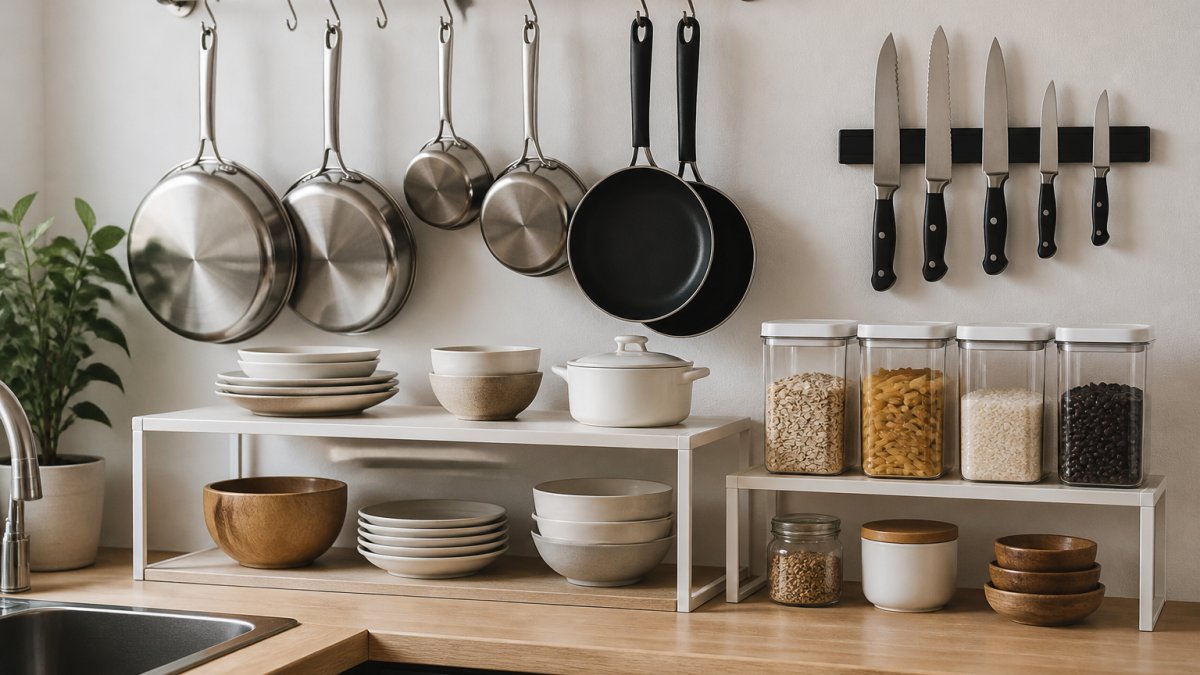
Small kitchens fail because everything competes for the same 18 to 24 inches of counter depth. Reclaim the walls and cabinet interiors.
- Wall-mounted rail with hooks. A rail above the counter holds pots, pans, and utensils and frees cabinet space. Mount it 18 to 24 inches above the counter so tall pots clear the surface.
- Magnetic knife strip. Frees a drawer and keeps knives within reach. Mount it away from the stove to avoid grease buildup.
- Cabinet risers and stackable shelves. A riser creates a second tier inside a cabinet, roughly doubling usable shelf area, the cheapest per-square-foot upgrade in the kitchen.
Bedroom and closet organization
- Slim hangers. Slim, flocked hangers take noticeably less rod space than wood or plastic, fitting more clothes in the same closet.
- Double-hang rod. A second rod below the existing one roughly doubles hanging space for shirts and folded-over pants. Leave at least 40 inches for long items like dresses and coats on the upper rod.
- Shelf dividers. Keep stacks of sweaters and jeans from toppling and let you stack higher without collapse.
Bathroom storage
Bathrooms are the smallest and most humid rooms, so material choice matters as much as placement.
LED Cabinet Light with Motion Sensor →
- Over-the-toilet shelf or cabinet. Uses dead wall space above the toilet. Confirm it clears the tank lid and any plumbing.
- Adhesive or tension shower caddies. Rust-resistant finishes (stainless steel, coated aluminum) last longer in a wet environment.
- Under-sink organizers. A two-tier sliding organizer or stack of clear bins makes the awkward under-sink space usable. Avoid storing paper goods directly under a leak-prone sink.
Entryway storage
- Wall hooks at 66 to 72 inches. High enough for coats to clear the floor, low enough for most adults to reach.
- A slim shoe cabinet. Look for 8 to 12 inches of depth; deeper cabinets block narrow hallways.
- A bench with cubbies. Gives a place to sit and put on shoes while storing them underneath.
Living area storage
- Media console with closed storage. Hides cables, remotes, and games while supporting the TV.
- Floating shelves above the sofa or TV. Keep them shallow (8 to 10 inches) so they don't crowd the room.
- Baskets on open shelves. Corral small items so open shelving looks intentional rather than cluttered.
Photograph each finished zone once it's organized. The photo becomes your reference for where things belong, which makes it far easier to reset the room after a busy week.
Renter-safe installation, by method
- Adhesive hooks and strips. Best for light items on smooth, clean, painted surfaces. Follow the cure time before hanging anything, and remove slowly per the manufacturer's instructions to avoid paint damage.
- Tension rods. No drilling. Use them inside closets, cabinets, and between window frames for lightweight items only.
- Over-the-door organizers. No installation at all. Check that the door still closes and the bracket doesn't damage the top of the door.
Never drill or paint without permission, even if you plan to fix it later. Damage-free options are faster, cheaper, and safer, and they move with you.
Safety and weight limits
- Anchor tall furniture. Bookcases, wardrobes, and tall cabinets can tip. Use the manufacturer's anti-tip kit or a wall anchor rated for the unit.
- Respect shelf load ratings. Glass and floating shelves have published limits; distribute weight evenly and put heavy items on lower shelves.
- Keep exits clear. Never stack storage in front of doors, windows, or the path to them, a safety rule and a lease requirement in most buildings.
- Mind reachability. Store heavy or frequently used items between knee and shoulder height. Reserve high shelves for light, occasional items.
Budget tiers for a room-by-room plan
- Low-cost: risers, tension rods, adhesive hooks, clear bins, shelf dividers, lazy Susan.
- Mid-range: wall rails, over-the-door organizers, under-sink organizers, slim shoe cabinets, floating shelves.
- Higher-cost: pull-out cabinet drawers, wall-mounted folding tables, anchored wall systems, solid-wood storage furniture.
Start with the room you use most and the tier you can afford. A measured, renter-safe plan in one room beats scattered purchases across five.
Use Under-Bed Storage and Hidden Solutions
Under-bed storage is free space most people ignore. Bed risers give you height to slide containers underneath for off-season clothes, extra bedding, or infrequently used items.
Use clear containers so you can see inside without pulling them out, label each one, and keep a phone list of what's stored where.
Hidden storage doesn't mean forgotten storage. Keep only items you use, rotate seasonal items in and out, and check your storage regularly so nothing gets lost.
Renter-Safe Installation and Damage-Free Storage
Renting means you can't drill holes or paint walls, but plenty of options leave no permanent marks.
Freestanding shelving units work in any apartment without wall mounting.
Use furniture to define spaces without permanent changes. A bookshelf divides a studio into separate zones.
When you move, these solutions come with you. Nothing stays behind except maybe some small adhesive residue that wipes away.
Never drill or paint without permission, even if you plan to fix it later. Landlords charge for damage repairs. Damage-free options are faster, cheaper, and safer.
Storage Containers, Bins, and Organization Systems
The right containers make storage work. Mismatched bins look chaotic; matching containers create visual calm even when full.
Stackable containers maximize vertical space. Modular crates fit together like puzzle pieces.
Drawer dividers stop items shifting, shelf risers create a second tier, and magazine holders store files, papers, and thin items vertically.
Match your storage style to your apartment: woven baskets feel warm, metal shelves look modern and industrial, wood containers add warmth.
Small apartments don't require expensive solutions. At LumBrook, we stock storage solutions like our LED Cabinet Light with Motion Sensor ($57.84) and Bathroom Wall-mounted Storage Rack ($121.93) that turn small spaces into organized, functional homes.

Frequently Asked Questions
What's the best way to start maximizing storage in a small apartment?
Start by decluttering and assessing what you actually use and need. Remove items you haven't touched in a year, donate duplicates, and be honest about what adds value to your life. Once you know what stays, measure your spaces and prioritize vertical storage solutions like wall-mounted shelves, hooks, and over-the-door organizers. These take advantage of wall space without eating into your floor area, which is critical in small apartments.
How can I add storage without damaging walls as a renter?
Use adhesive hooks, damage-free picture hanging strips, and tension rods that require no drilling. Freestanding shelving units and storage furniture are excellent alternatives to wall-mounted options. Command hooks and strips are designed to come off cleanly without leaving marks. For temporary solutions, lean-to shelves and over-the-door organizers work well. Always check your lease for specific restrictions, and test any adhesive product on a small, inconspicuous area first.
What type of multifunctional furniture works best for small apartments?
Look for pieces that serve double duty: ottomans with hidden storage, beds with drawers underneath, fold-down desks, and rolling islands for kitchens. Coffee tables with shelving, benches with storage, and wall-mounted drop-down tables maximize function while minimizing footprint. These pieces help you store more while keeping your floor space open, which makes small apartments feel larger and less cramped.
How do I organize my kitchen in a small apartment with limited cabinet space?
Use vertical space with wall-mounted shelves or open shelving for frequently used items like pots, pans, and dishes. Hang hooks inside cabinet doors for mugs and utensils. Install a wall-mounted spice rack or magnetic strip for knives. Stackable containers and modular crates maximize cabinet depth. Consider a rolling kitchen island for extra counter and storage space. The LED Cabinet Light with Motion Sensor ($57.84) is ideal for illuminating dark cabinets and making items easier to find while keeping your space organized.


