


Table of Contents
- What Makes a Draining Basket Work in Small Kitchens
- Key Features: Multifunctional Design, Materials, and Drainage
- Collapsible Kitchen Drain Basket Options
- Expandable Sink Drain Basket for Flexible Fit
- Over-the-Sink Colander: Setup and Compatibility
- Plastic Kitchen Strainer with Handle: Best Uses
- LumBrook Multifunctional Draining Basket: Verdict
- Common Mistakes to Avoid When Choosing a Drain Basket
- Frequently Asked Questions
Last Updated: October 12, 2026
What Makes a Draining Basket Work in Small Kitchens
A multifunctional draining basket small kitchens need solves a real problem: washing, draining, and preparing food when counter space is a luxury.

A basket that's too large becomes a permanent fixture you can't store; one too small defeats the purpose.
Tiny holes clog easily; oversized holes let smaller items slip through. The ideal design uses strategically sized holes that let water escape while keeping food secure.
Key Features: Multifunctional Design, Materials, and Drainage
The best draining baskets do more than one job: they rinse produce, drain pasta, hold utensils, and store food in the refrigerator. That versatility matters in small kitchens, where a single-purpose tool takes up space you don't have.
Stainless Steel vs. Plastic Construction
Stainless steel draining baskets look professional and last longer, but cost more and take up permanent space. Plastic keeps costs down and allows collapsible designs that store flat, though durability is the trade-off.
Both are acceptable when food-safe. Stainless steel doesn't absorb odors or stains; plastic can, especially after garlic, beets, or turmeric.
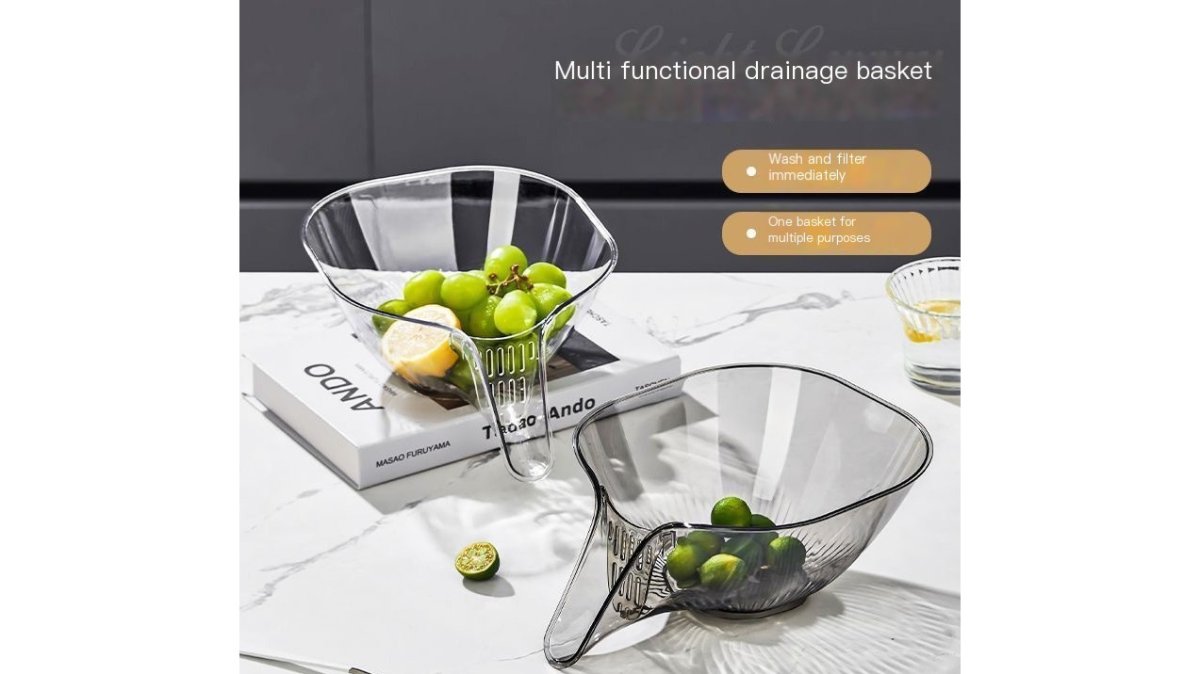
The LumBrook Multifunctional Draining Basket uses high-quality PP plastic, which resists staining and maintains its appearance.
Drainage Holes and Water Flow
Drainage hole size determines what the basket can handle. Small holes suit leafy greens and berries; larger holes drain pasta and heavier vegetables faster. The best designs vary hole sizes, smaller at the edges, larger in the center, to balance speed with security.
Water flow depends on angle too. A basket that tilts slightly toward the drain moves water efficiently; one that sits flat pools water in corners. Look for a subtle bowl shape that directs water downward.
Basket Dimensions and Capacity
Small kitchen draining baskets typically range from 8 to 12 inches in diameter, with depths of 3 to 5 inches. A 10-inch basket handles most household washing without overwhelming a compact sink. Capacity matters less than you'd think, most people wash produce in batches, so medium beats oversized.
| Basket Size | Best For | Typical Capacity |
|---|---|---|
| 8-9 inches | Single servings, small produce | 2-3 cups |
| 10-11 inches | Standard household use | 4-6 cups |
| 12+ inches | Large batches, less frequent use | 7+ cups |
Collapsible Kitchen Drain Basket Options
A collapsible kitchen drain basket solves the storage problem entirely. When not in use, it folds flat or collapses to a fraction of its size, ideal in apartments, tiny homes, and RVs where every inch matters.
A typical 10-inch round basket stands about 4 inches tall when open; a collapsible version compresses to roughly 1.5 to 2 inches, a 50 to 60 percent reduction in vertical height.
How the Collapsing Mechanism Actually Works
Collapsible baskets use one of three mechanisms, and the mechanism determines how long the basket lasts:
- Accordion ribs. Concentric rings of flexible material compress like a bellows. Fewest moving parts, longest lifespan, but the ribs can trap food residue in the folds.
- Hinged panels. Rigid plastic panels connected by hinges fold inward or downward. Sits more stably when open, but each hinge is a stress point that can crack with repeated flexing.
- Telescoping walls. Nested rigid sections slide down into each other. Most stable of the three, but usually the bulkiest when collapsed.
Look for reinforced hinge joints and a locking mechanism, a tab, a rim lip, or a twist-lock, that holds the basket rigidly open. Without a lock, a hinged or accordion basket can sag under the weight of wet produce and tip toward the drain.
The Real Trade-Offs
The downside of collapsible designs is that flexibility and rigidity pull against each other. A basket soft enough to fold is usually less stable when expanded, and fold lines collect water and debris that a smooth one-piece basket sheds easily.
For small kitchens, the storage advantage often outweighs these concerns, but only if you clean the folds. After each use, rinse the collapsed basket under running water while flexing it open and closed so water flushes the creases.
Storage Footprint Comparison
Use this as a rough planning guide when deciding between a rigid and a collapsible basket. Numbers are typical ranges, always check the specific product's stated folded dimensions.
| Design | Open Height | Collapsed Height | Best Storage Spot |
|---|---|---|---|
| Rigid round basket | 3-5 in | Does not collapse | Cabinet shelf, counter |
| Accordion collapsible | 3-4 in | 1.5-2 in | Drawer, narrow shelf gap |
| Hinged-panel collapsible | 3-4 in | 1.5-2.5 in | Drawer, cabinet |
| Telescoping | 3-5 in | 2-3 in | Cabinet shelf |
If your only free storage is a 2-inch drawer, an accordion or hinged-panel design is your best bet. If you have a full cabinet shelf, a rigid basket is more stable and easier to clean.
Expandable Sink Drain Basket for Flexible Fit
An expandable sink drain basket adjusts to fit different sink widths. This matters if you have an unusually narrow or wide sink, or if you're renting and can't modify your space. Expandable designs use telescoping arms or adjustable feet to accommodate variation.
Measure Your Sink Before You Buy
This is the step almost every product listing skips, and the biggest cause of returns. Before shopping, measure three things:
- Basin width at the rim. Measure across the widest point of the sink opening, inside edge to inside edge. Most compact kitchen sinks fall between 24 and 30 inches wide overall, but the usable basin is narrower.
- Divider clearance. If you have a double-bowl sink, measure the width of the bowl you plan to use, not the whole sink. A basket that spans both bowls will not sit flat over the divider.
- Rim shape and mounting style. Drop-in and top-mount sinks have a raised rim the basket can rest on. Undermount sinks have no exposed rim, so an over-the-sink or expandable basket that relies on rim contact will not work, you need a basket that sits inside the basin or on the counter beside it.
A common pattern is buying a basket that fits the sink's overall width but not the individual bowl, then discovering it tips every time you set it down. Measure the bowl, not the sink.
Telescoping Arms vs. Adjustable Feet
Expandable baskets achieve their range in two ways:
- Telescoping arms. Two or more sliding rails extend outward to bridge the sink. These give the widest adjustment range and work well over single-bowl sinks. The rails are also the most common failure point, grit and food particles work into the sliding channels and make them stiff or stuck.
- Adjustable feet or base. The basket's base widens or the feet reposition to sit inside different basin sizes. More stable than telescoping arms because there are fewer sliding parts, but the adjustment range is narrower.
The trade-off is stability. An expandable design has more moving parts and failure points, and the basket may shift if the mechanism loosens. A well-engineered expandable draining basket for small kitchens stays put; a cheap one becomes frustrating.
Multifunctional Draining Basket and Bowl for Kitchen →
Keeping an Expandable Basket Clean and Odor-Free
Expandable baskets collect debris in the hardest-to-reach places: sliding channels, the joints where arms meet the basket body, and the underside of the rim. This is where odors start.
A simple routine prevents most of it:
- After draining pasta, rice, or anything starchy, rinse the basket immediately. Starch dries into a glue-like film that traps particles in the channels.
- Once a week, extend the arms fully and flush the channels with warm water. A soft bottle brush or an old toothbrush reaches into the rails.
- Every few weeks, soak the basket in warm water with a splash of white vinegar to break down mineral film and lingering smells. Rinse thoroughly and let it air-dry fully extended so water does not sit in the joints.
When an Expandable Basket Is the Right Choice
Choose expandable if your sink is an unusual width, if you rent and cannot change fixtures, or if you want one basket that works across multiple sinks. Choose a fixed-size basket if your sink is standard and you value stability and easy cleaning. For most compact kitchens, a fixed basket that fits the bowl correctly beats an expandable one that fits everything approximately.
Over-the-Sink Colander: Setup and Compatibility
An over-the-sink colander rests on the sink rim, extending across the basin and keeping the basket elevated so water drains directly into the sink.
The advantage is that your counter stays clear. The disadvantage is that the basket is always in view and always installed. You can't put it away. For small kitchens where visual clutter matters, this might not be ideal.
Plastic Kitchen Strainer with Handle: Best Uses
A plastic kitchen strainer with a handle is the simplest option: portable, affordable, and easy to store. Handles make one-handed operation convenient, and a good design keeps water from dripping on your arm or counter.
Plastic strainers work best for small, frequent tasks: draining canned vegetables, rinsing a handful of berries, or holding pasta while you plate it. For larger washing jobs, they're tedious.
LumBrook Multifunctional Draining Basket: Verdict
The LumBrook Multifunctional Draining Basket and Bowl for Kitchen at $24.74 delivers real value for small kitchen spaces. It's crafted from high-quality PP plastic, which resists warping and food stains better than budget alternatives.
The drainage design works: water flows efficiently through strategically sized holes, and the bowl shape naturally directs water toward the drain.
This is the draining basket small kitchens need most, and we recommend it. It balances capacity, durability, and price.
FDA guidance on food contact materials
Common Mistakes to Avoid When Choosing a Drain Basket
The first mistake is buying based on looks alone.
The second mistake is choosing something too large.
The third mistake is assuming all plastic is the same. Budget plastic discolors, warps, and cracks easily.
The fourth mistake is ignoring drainage capacity.
The fifth mistake is forgetting about storage.
Small kitchens demand tools that work harder and take up less space.
USDA recommendations for produce washing
Consumer Reports guide to kitchen organization
Frequently Asked Questions
What size multifunctional draining basket fits a small sink?
For small sinks, look for baskets with a diameter under 9 inches and depth under 4 inches. The LumBrook Multifunctional Draining Basket ($24.74) is designed with compact sizing in mind, fitting most standard and undersized sink bowls. Measure your sink basin width before purchasing to ensure the basket won't crowd your workspace or prevent water from flowing freely around it.
Are collapsible kitchen drain baskets better for small kitchens?
Collapsible drain baskets save storage space when not in use, making them ideal for small kitchens with limited cabinet room. They fold down to a fraction of their full size, though they may take slightly longer to expand and secure than fixed models. If storage is your main constraint, collapsible options are worth considering; if you need quick daily access, a compact fixed basket might be more practical.
What can you use a kitchen draining basket for besides washing vegetables?
A multifunctional draining basket works for rinsing fruits, draining pasta, washing small kitchen utensils, straining canned foods, and collecting food scraps during prep. The spacious bowl design allows water to drain easily while the basket holds items securely. Some users also store produce temporarily or use it as an organized food container on the counter during meal prep.
Should I choose plastic or stainless steel for a small kitchen drain basket?
Plastic construction, like the high-quality PP material in the LumBrook basket, is lightweight, affordable ($24.74), and food-safe, making it ideal for small spaces where weight and ease of handling matter. Stainless steel offers greater durability and a professional look but costs more and takes up the same footprint. For small kitchens on a budget, plastic delivers reliable performance without sacrificing space.


